

The research project “DiKey – Digital Key Technologies for Determining Material Properties for Efficient Material Separation in the Chemical Industry” is developing new data-driven methods to enable faster and more sustainable design of chemical processes. The goal is to use machine learning methods to accurately predict material data, reduce the need for time-consuming experimental studies, and support the selection of optimal process configurations for separation and synthesis processes with simulation.
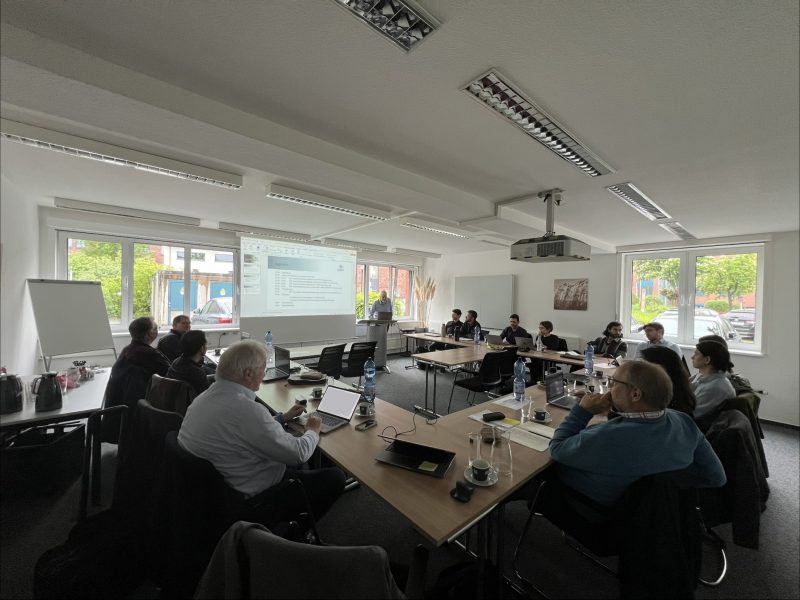
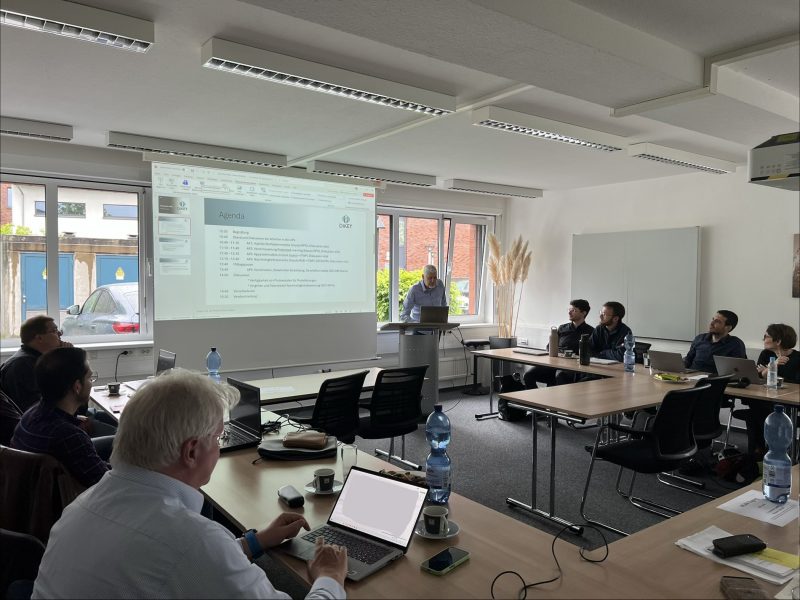
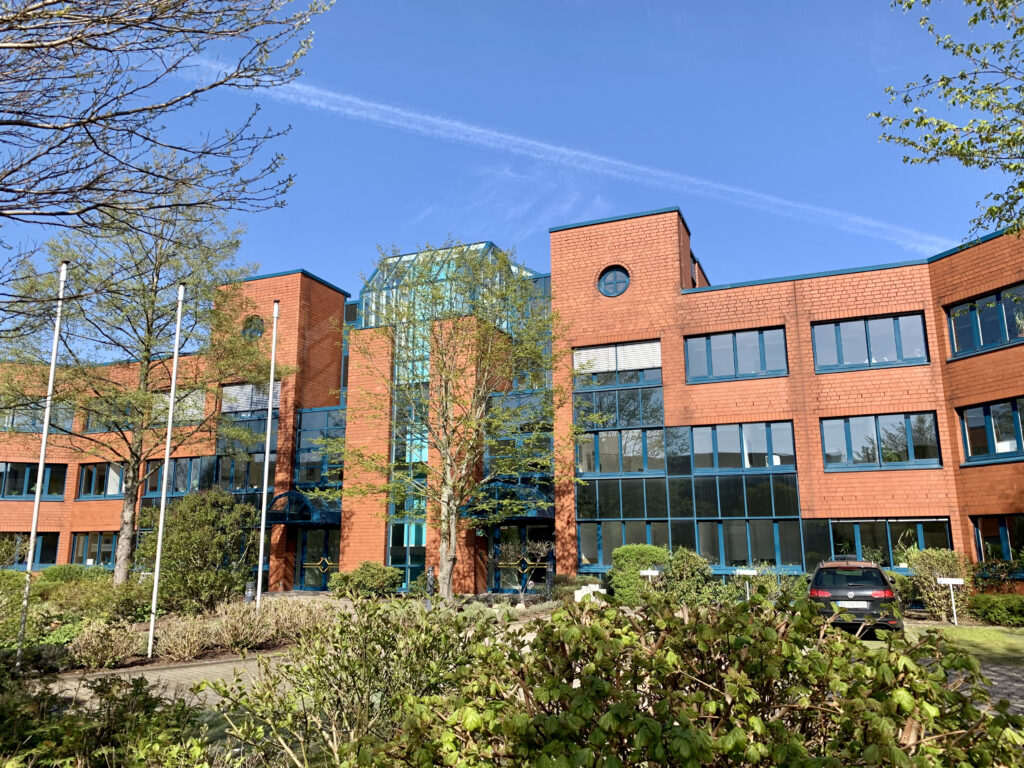
On May 6, the second project meeting took place at the INOSIM GmbH premises in Dortmund. Sixteen participants from the participating institutes (RPTU, ITWM, RUB, DECHEMA) and companies (Bayer, Evonik, INOSIM) discussed the current progress in the project:
- Prof. Fabian Jirasek (Rheinland-Pfälzische Technische Universität, RPTU) presented his department’s latest advances in the development of hybrid material data models by combining flexible machine learning algorithms with physical knowledge, which, for example, enable the prediction of phase equilibria and critical parameters in the design of equipment and processes based solely on molecular structure.
- Pascal Zittlau from Prof. Fabian Jirasek’s department and Jonas Koch from Prof. Stefanie Roos’ department (RPTU) presented the current status of their research in the field of federated learning, a key component of the project that enables AI models to be trained using anonymized data from industry partners.
- Jennifer Werner, Dr. Miltiadis Poursanidis (both from Prof. Michael Bortz’ department at Fraunhofer-Institut für Techno- und Wirtschaftsmathematik, ITWM) and Dr. Alexander Salten (INOSIM) demonstrated the derivation of surrogate models from material data models to perform fast and efficient apparatus simulations and integrate them with the process simulation software INOSIM.
- Felix Pasch (chair of Prof. Marcus Grünewald, Ruhr-Universität Bochum, RUB), Dr. Miltiadis Poursanidis presented the current status of their work on the characterization and optimization of hybrid separation processes that combine distillation and pervaporation. Together with Dr. Christina Andreeßen and Johanna Valasko Gassenheimer (both from DECHEMA), they then discussed the impact of more precise material data on the efficiency of such and other processes, and how LCA-based criteria can be systematically integrated into modeling and optimization in the future to better account for environmental impacts.
- Concluding the event, Dr. Ulrich Westhaus (DECHEMA Gesellschaft für Chemische Technik und Biotechnologie e.V.) addressed several organizational matters, including plans for a workshop on developments arising from “DiKey” for interested parties from industry and research.
Our conclusion: a productive meeting featuring focused discussions and a clear plan for the next steps. During the subsequent discussion, additional ideas for research and development were also discussed and fleshed out. We look forward to continuing our collaboration on this project.
Do you have any questions or would like to know more about this topic? Please contact us.
 General Inquiries