


From June 21 to 24, 2026, the ESCAPE36 – European Symposium on Computer Aided Process Engineering took place at the University of Sheffield. The international conference is an important meeting point for the Process Systems Engineering community. Under the guiding theme “Resilient Sustainability through CAPE”, the focus was on robust, adaptive, and sustainable process systems — particularly approaches involving modeling, simulation, optimization, and data-driven decision support.
Simulation Optimization for Real-Time Production Scheduling
As part of the conference, the paper “Simulation-Optimization vs. MILP Approaches for Real-Time Scheduling of Multiproduct Batch Plants” by Engelbert Pasieka and Prof. Dr.-Ing. Sebastian Engell was presented as a conference talk. The peer-reviewed contribution was published in the ESCAPE 36 proceedings in Systems & Control Transactions, Volume 5, pages 2370–2376, available at https://psecommunity.org/LAPSE:2026.0200.
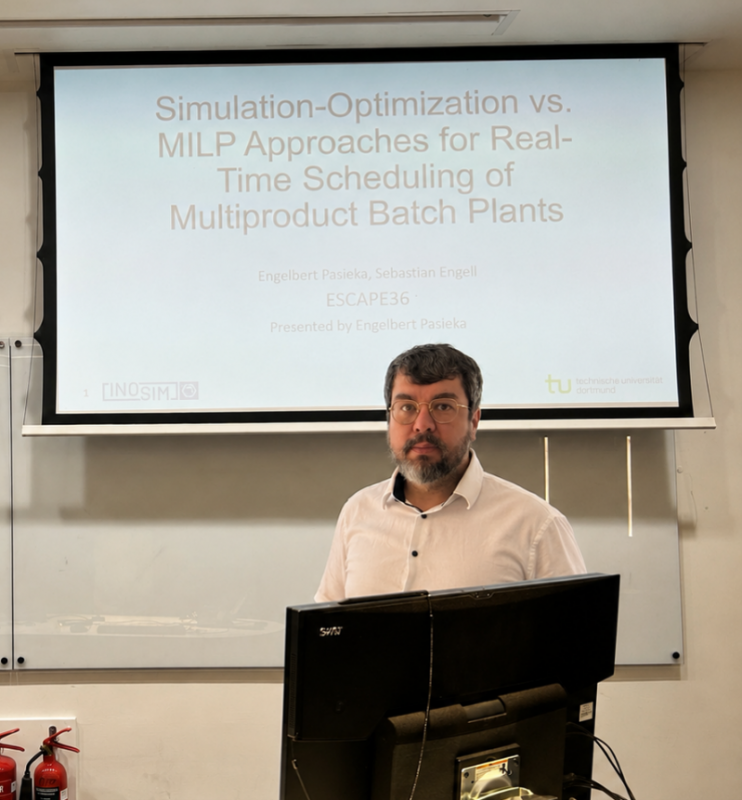
Engelbert Pasieka is an employee of INOSIM and is also pursuing a doctorate on the topic of real-time production scheduling using simulation models. The presented contribution is directly related to this research topic: it investigates how production schedules in multiproduct batch plants can be adapted at short notice when disruptions occur, such as rush orders, maintenance activities, machine breakdowns, or changes in processing times.
Comparing Simulation Optimization and MILP
The paper compares two approaches for real-time production scheduling: a simulation-optimization based approach that combines discrete-event simulation with an evolutionary algorithm, and a sequence-based MILP model (mixed-integer linear programming). Both approaches were embedded in an event-driven rolling-horizon framework, in which the schedule is updated regularly and in response to disruptions.
The results show that MILP models can perform well in stable situations and when sufficient computation time is available. Under strict time constraints and dynamic disruptions, however, simulation optimization proved to be particularly responsive. In static tests, the evolutionary approach achieved makespan values that were on average around 7–13% better than those of the MILP approach. In real-time scenarios with 40 initial orders, maintenance events, and three rush orders, the simulation-based optimization approach also showed an advantage: It can reuse existing search information across multiple updates and quickly adapt production schedules.

From Research to Industrial Practice
By presenting the work at ESCAPE 36, the research was discussed in a highly relevant professional environment. For INOSIM, the contribution highlights the importance of simulation models as a foundation for robust, fast, and practical decision-making in production scheduling — especially in environments where production systems must continuously respond to new events.
These research results are highly relevant for the further development of INOSIM Foresight and simulation-based decision support in ongoing production. INOSIM Foresight uses process simulations to generate high-quality forecasts for batch production. Foresight supports production staff, planners, management, and maintenance teams in making faster and better-informed decisions.
If you would like to exchange ideas with Engelbert Pasieka on research topics related to real-time production scheduling, simulation optimization, or INOSIM Foresight, please contact him directly via LinkedIn or drop a message for him via our contact form.
Get in touch and learn how INOSIM can revolutionize your decision-making process today.
 General Inquiries